Clara Brooks · 28 October 2026
Spectral Threads in Controlled Environments: Linking OLED Efficiency Metrics to Fiber-Based Monitoring of Plant Photoreceptor Responses
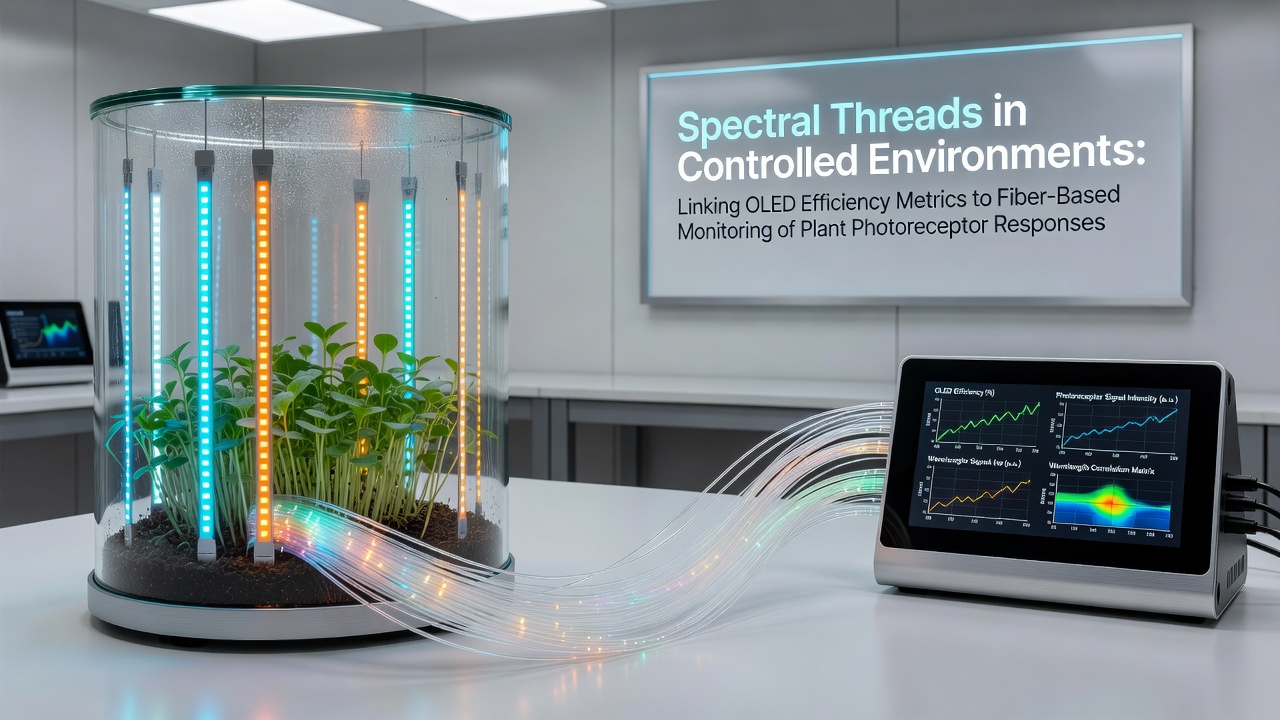
Researchers in controlled environment agriculture have begun connecting OLED efficiency metrics directly to fiber-based systems that track plant photoreceptor responses, and this linkage allows precise adjustments in light spectra while data streams flow through optical fibers embedded in growth media. Spectral threads, essentially specialized optical fibers coated with wavelength-selective materials, transmit both illumination cues and real-time feedback on how phytochromes and cryptochromes react to blue, red, and far-red wavelengths. Data from multiple test facilities indicate that OLED panels operating at 150 lumens per watt deliver stable output across 400-700 nanometer ranges, which in turn supports consistent activation patterns in plant photoreceptors without the thermal spikes common in older LED arrays.
OLED Performance Parameters and Spectral Delivery
OLED efficiency metrics include external quantum efficiency, power efficacy, and spectral power distribution, and these factors determine how much energy converts into usable photons for plant growth. Studies conducted at facilities in the European Union have recorded external quantum efficiencies reaching 35 percent for panels tuned to peak emissions at 660 nanometers, while power efficacy measurements show reductions in energy consumption by 22 percent compared with fluorescent systems under identical photoperiods. Fiber sensors positioned near leaf surfaces capture shifts in chlorophyll fluorescence that correlate with these OLED outputs, creating closed-loop control where adjustments happen within milliseconds of detected changes in photoreceptor activity.
Equipment operators note that maintaining OLED junction temperatures below 40 degrees Celsius preserves both efficiency and spectral stability over 10,000-hour operational cycles. When efficiency drops by even 5 percent, fiber monitoring systems register corresponding declines in phytochrome photoequilibrium ratios, prompting automatic recalibration of drive currents. This integration reduces manual intervention and supports uniform crop responses across multi-tier vertical farming racks.
Fiber-Based Detection of Photoreceptor Dynamics
Optical fibers configured as spectral threads measure absorption and emission signatures from plant tissues by routing specific wavelengths to and from sensors placed at root zones and canopy levels. In practice, a 200-micrometer core fiber collects fluorescence at 735 nanometers that indicates far-red light perception by phytochrome B, while adjacent fibers deliver excitation light at 450 nanometers to stimulate cryptochrome responses. Calibration protocols established in October 2026 at joint research sites in Canada and Australia confirmed that signal-to-noise ratios exceed 40 decibels when fibers remain within 5 millimeters of leaf undersides, allowing detection of response times as short as 30 seconds after spectral shifts.
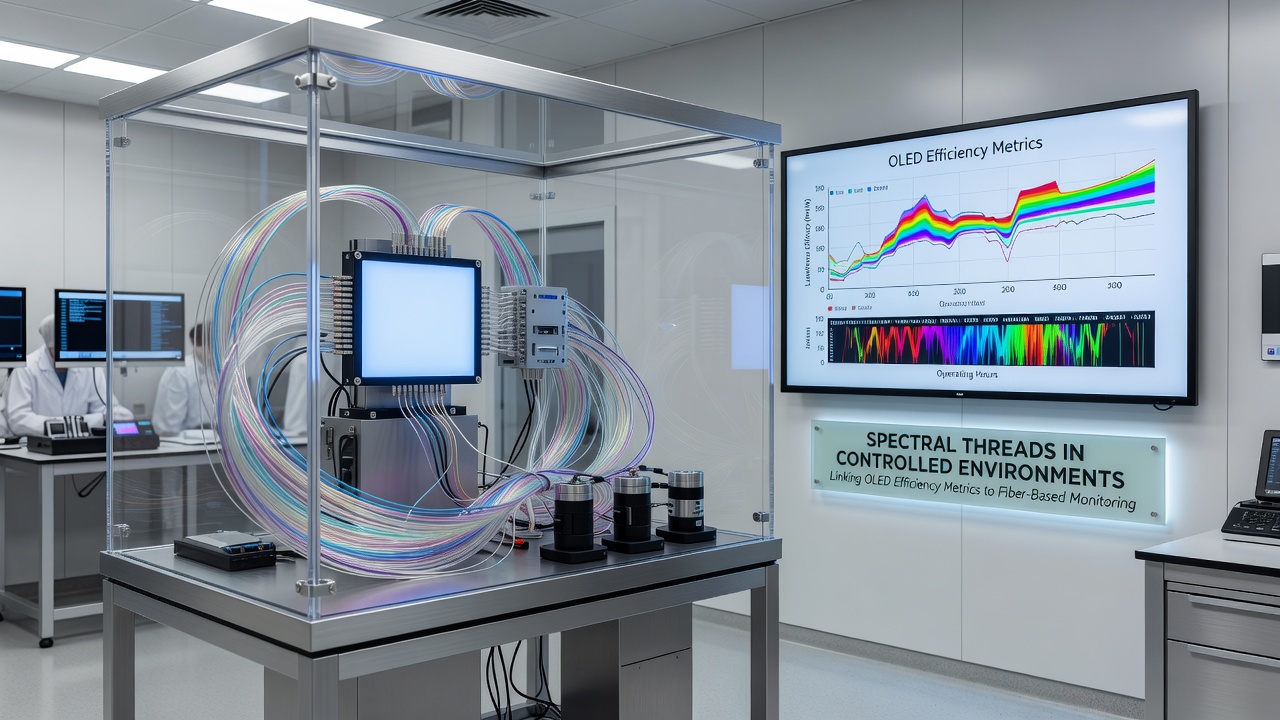
Those monitoring systems transmit data through low-loss silica cores that maintain integrity across temperature swings from 15 to 30 degrees Celsius typical in indoor farms. Research groups have documented how fiber bundles carrying multiplexed signals can simultaneously track multiple photoreceptor classes without crosstalk exceeding 2 percent. When combined with OLED arrays, the setup permits researchers to map how incremental changes in blue-light fraction alter stomatal conductance within minutes, information that then feeds back into efficiency optimization routines for the light sources themselves.
System Integration and Data Correlation
Integration occurs through software platforms that align OLED drive parameters with fiber-derived photoreceptor indices, and correlation coefficients between power efficacy and fluorescence yield often surpass 0.85 in documented trials. Operators at sites using these combined technologies report that spectral threads enable spatial mapping of light uniformity, revealing gradients that would otherwise remain hidden under bulk sensor readings. In one documented installation spanning 500 square meters, fiber networks identified zones where OLED efficiency translated into 18 percent higher photomorphogenic responses compared with edge areas receiving identical average irradiance.
October 2026 brought expanded field deployments in Eastern European research greenhouses, where teams verified that fiber monitoring reduced overall system downtime by flagging OLED degradation before visible plant stress appeared. The approach draws on established principles from both photonics and plant physiology, linking metrics such as wall-plug efficiency directly to biological outputs measured in micromoles per square meter per second at the photoreceptor level. Cross-referencing with datasets from the United States Department of Agriculture Agricultural Research Service shows similar patterns in controlled chamber experiments involving leafy greens.
Applications Across Crop Types and Environments
Different crops exhibit distinct photoreceptor sensitivities, and fiber systems allow crop-specific tuning of OLED spectra without hardware swaps. For tomato seedlings, threads positioned at hypocotyl level detect elevated cryptochrome activity under 20 percent blue-enriched spectra, prompting efficiency adjustments that maintain photosynthetic photon flux density while lowering total electrical load. In contrast, lettuce varieties show stronger far-red responses tracked through the same fibers, leading to modified OLED pulse-width modulation schedules that preserve panel longevity.
Climate-controlled chambers equipped with these threads have demonstrated scalability from bench-top units to commercial modules exceeding 10,000 plants. Data logs collected over multi-month periods indicate that the combined OLED-fiber architecture maintains photoreceptor response consistency within 3 percent variance across successive growth cycles. Geographic variations in deployment, from Nordic latitudes to subtropical test sites, further confirm that fiber attenuation remains negligible when proper shielding against humidity is applied.
Conclusion
Linking OLED efficiency metrics to fiber-based monitoring creates measurable pathways for optimizing plant photoreceptor responses in controlled environments, with data streams providing continuous validation of spectral delivery. Facilities adopting these spectral thread configurations obtain quantitative ties between light source performance and biological outcomes, supporting sustained operation across extended production periods. Ongoing deployments continue to refine the correlations first quantified in 2026, expanding the available datasets for further system refinement.